> ## Documentation Index
> Fetch the complete documentation index at: https://docs.assuric.com/llms.txt
> Use this file to discover all available pages before exploring further.
# Choosing what to publish
> Which documents customers ask for, and the approval step people miss.
**Quick summary**
* An authored document has to be *Approved* before you can add it to your Trust Centre.
* Publish a hazard log to show customers an always-current web view for each product, not a PDF.
* Custom frameworks, for things like a NIS 2 certificate, are off until our team switches them on.
## Approve, then publish
An authored document can be added only once it's [*Approved*](/documents/versions-and-version-history). Customers see that version, so editing the draft changes nothing until you approve the next one and move the resource to it.
Evidence, PDFs and certificates don't need the *Approved* status that authored documents do. Nothing in your evidence bank is public until you add it to your Trust Centre.
## What customers ask for
* Certificates: Cyber Essentials, Cyber Essentials Plus, ISO 27001 and DSPT
* Clinical Safety Case Report, Hazard Log and Clinical Risk Management Plan, your DCB0129 set
* [DPIAs](/assuric-overview/glossary#abbreviations) and other templates
## Publishing a hazard log
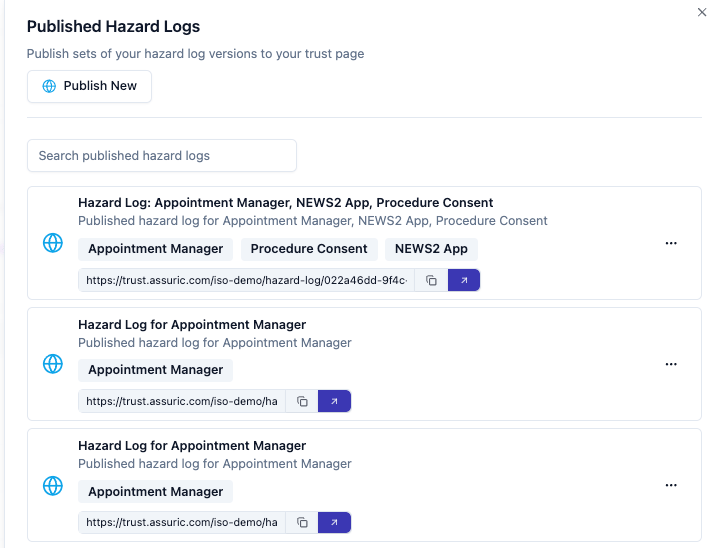
**Publish** on a [hazard log](/clinical-safety/sharing-and-publishing) puts an always-current web view of it on your Trust Centre, easier to read than a PDF. Customers can still download it as a spreadsheet.
 ## Framework badges, statuses and custom frameworks
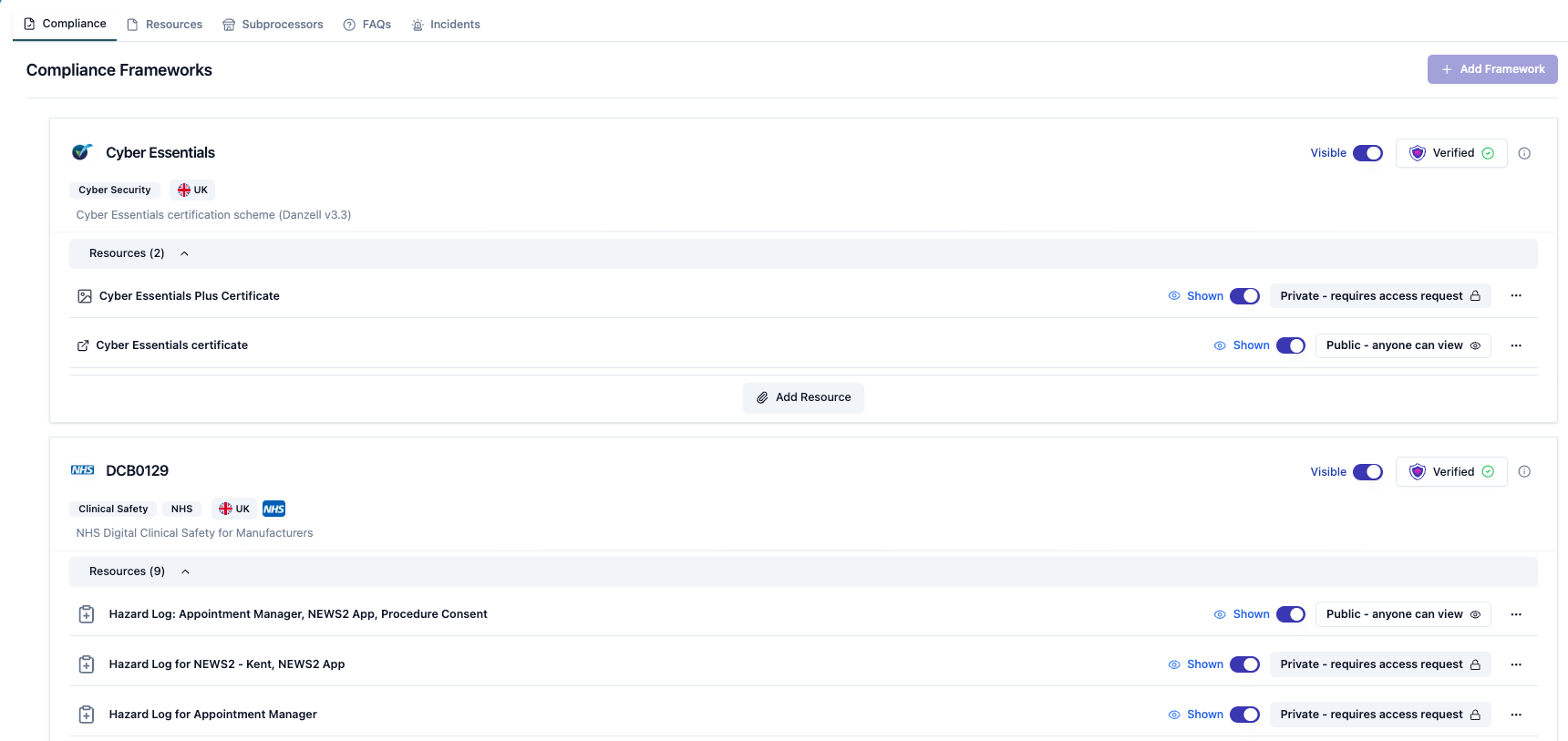
Get in touch with our team for a *verified by Assuric* badge.
Custom frameworks show an assurance Assuric doesn't track, such as a NIS 2 certificate or a CREST penetration test. Ask our team to switch them on for your workspace; until then, **Add Framework** is greyed out. To add one (admins only):
1. Go to **Trust Centre → Page Content → Compliance** and click **Add Framework**.
2. Enter a *Label*, such as `NIS 2`, upload a square logo, and add a *Description*, a *Status* (*Active* or *In Progress*) and the *Countries / Regions* it covers.
3. Leave *Visible on Trust Page* on to show it straight away, or turn it off to add it hidden. Then click **Create Framework**. It appears in your list tagged *Custom*.
* It works like your other frameworks: you can attach resources to it, each public or by access request.
* Admins can edit or delete it from its card.
* It appears only on your Trust Centre, not under **Frameworks**, because it isn't linked to compliance tracking.
Deleting a custom framework removes it from every Trust Centre view and can't be undone.
## Framework badges, statuses and custom frameworks
Get in touch with our team for a *verified by Assuric* badge.
Custom frameworks show an assurance Assuric doesn't track, such as a NIS 2 certificate or a CREST penetration test. Ask our team to switch them on for your workspace; until then, **Add Framework** is greyed out. To add one (admins only):
1. Go to **Trust Centre → Page Content → Compliance** and click **Add Framework**.
2. Enter a *Label*, such as `NIS 2`, upload a square logo, and add a *Description*, a *Status* (*Active* or *In Progress*) and the *Countries / Regions* it covers.
3. Leave *Visible on Trust Page* on to show it straight away, or turn it off to add it hidden. Then click **Create Framework**. It appears in your list tagged *Custom*.
* It works like your other frameworks: you can attach resources to it, each public or by access request.
* Admins can edit or delete it from its card.
* It appears only on your Trust Centre, not under **Frameworks**, because it isn't linked to compliance tracking.
Deleting a custom framework removes it from every Trust Centre view and can't be undone.
 ## Subprocessors
Add each subprocessor with what it does and where it's based. Information governance teams use these details to check where data is held and that data processing agreements are in place.
## FAQs
FAQs answer what you'd otherwise get by email, like where you host data. Ours are at [trust.assuric.com/assuric/public/faq](https://trust.assuric.com/assuric/public/faq).
**What we recommend**
* Certificates and framework badges can be public. Clinical safety documents usually go behind an access request, as do sensitive ones such as a penetration test report.
* Add subprocessors that process patient data early, as you may be asked for them during procurement.
## Related articles
Public documents, access requests, expiry dates and who approves.
Update a published document and tell the people who hold it.
This documentation is built and hosted on [Mintlify](https://mintlify.com), a developer documentation platform.
## Subprocessors
Add each subprocessor with what it does and where it's based. Information governance teams use these details to check where data is held and that data processing agreements are in place.
## FAQs
FAQs answer what you'd otherwise get by email, like where you host data. Ours are at [trust.assuric.com/assuric/public/faq](https://trust.assuric.com/assuric/public/faq).
**What we recommend**
* Certificates and framework badges can be public. Clinical safety documents usually go behind an access request, as do sensitive ones such as a penetration test report.
* Add subprocessors that process patient data early, as you may be asked for them during procurement.
## Related articles
Public documents, access requests, expiry dates and who approves.
Update a published document and tell the people who hold it.
This documentation is built and hosted on [Mintlify](https://mintlify.com), a developer documentation platform.